---
title: New £20 million robotic AI lab to accelerate fight against deadly infections and help phase out animal testing
description: A new £20 million robotic AI lab in Liverpool aims to accelerate drug discovery for infectious diseases while phasing out animal testing.
image: https://lyvalabs.com/hubfs/Image4.jpg
---
[](https://lyvalabs.com/)
- About
- [Our purpose](https://lyvalabs.com/about)
- [Case studies](https://lyvalabs.com/case-studies)
- [Team](https://lyvalabs.com/team)
- [News](https://lyvalabs.com/news)
- [Annual Report](https://lyvalabs.com/annualreport25-26)
- [Investment](https://lyvalabs.com/investment-fund)
- Programmes
- [Adapt](https://lyvalabs.com/adapt)
- [Incubator](https://lyvalabs.com/incubator)
- [Accelerate](https://lyvalabs.com/accelerate)
- Services
- [Consortia](https://lyvalabs.com/consortia)
- Work with Us
- [Careers](https://lyvalabs.com/vacancies)
- [Consultants](https://lyvalabs.com/lyva-labs-expert-partner-opportunities)
[](https://lyvalabs.com/)
- About
- [Our purpose](https://lyvalabs.com/about)
- [Case studies](https://lyvalabs.com/case-studies)
- [Team](https://lyvalabs.com/team)
- [News](https://lyvalabs.com/news)
- [Annual Report](https://lyvalabs.com/annualreport25-26)
- [Investment](https://lyvalabs.com/investment-fund)
- Programmes
- [Adapt](https://lyvalabs.com/adapt)
- [Incubator](https://lyvalabs.com/incubator)
- [Accelerate](https://lyvalabs.com/accelerate)
- Services
- [Consortia](https://lyvalabs.com/consortia)
- Work with Us
- [Careers](https://lyvalabs.com/vacancies)
- [Consultants](https://lyvalabs.com/lyva-labs-expert-partner-opportunities)
[Contact Us](https://lyvalabs.com/contact)
[Contact Us](https://lyvalabs.com/contact)
Fri, Sep 4, 2026
# New £20 million robotic AI lab to accelerate fight against deadly infections and help phase out animal testing
[LYVA Labs](https://lyvalabs.com/news/author/lyva-labs)
Share: [Share this page on LinkedIn](http://www.linkedin.com/shareArticle?mini=true&url=https://lyvalabs.com/news/new-20-million-robotic-ai-lab-to-accelerate-fight-against-deadly-infections-and-help-phase-out-animal-testing) [envelope icon](mailto:?body=https://lyvalabs.com/news/new-20-million-robotic-ai-lab-to-accelerate-fight-against-deadly-infections-and-help-phase-out-animal-testing)
- UK-first high-security facility opens today (Sept 4) - supported by £10 million [Liverpool City Region Life Sciences Innovation Zone funding](https://www.liverpoolcityregion-ca.gov.uk/life-sciences-innovation-zone)
- Developed by [Liverpool School of Tropical Medicine](https://lstmed.ac.uk/) and the [Infection Innovation Consortium: iiCON](https://www.infectioninnovation.com/liverpool-robotic-infection-research-laboratory/)
- The Liverpool Accelerate Laboratory will fuse world-leading research with industry to accelerate drug and vaccine discovery
- It will enable cutting-edge automated organoid research – helping to phase out animal testing
- Lab set to generate £40 million of investment in the first three years – creating well-paid jobs in leading UK area for infection innovation
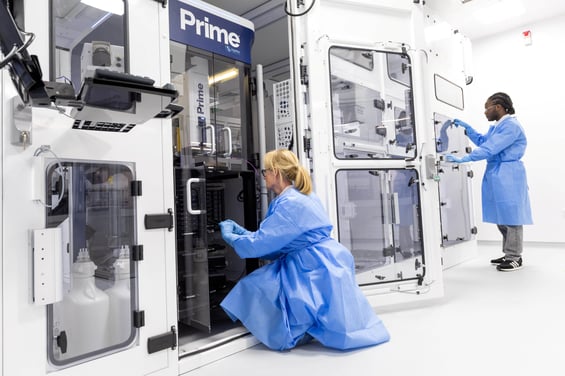
A new high-security robotic AI laboratory designed to accelerate the discovery of next-generation drugs and vaccines for high-risk and deadly infectious diseases has launched in Liverpool.
A first of its kind in the UK, the £20 million Liverpool Accelerate Laboratory will be open to industry and academics to develop innovative new treatments using human organoids that provide a more accurate indication of the impact of new treatments than tests based on animals.
The laboratory has been developed through the Infection Innovation Consortium: iiCON, which advances pioneering infection R&D through collaboration between industry, researchers and the NHS.
Built at Liverpool School of Tropical Medicine and supported by £10 million from the Liverpool City Region Life Sciences Innovation Zone programme, the new facility is due to open fully in 2027 and will provide a safe environment where partners can work with dangerous pathogens using cutting-edge automated technology.
The new secure Containment Level 3 (CL3) laboratory is fitted with state-of-the-art liquid handling systems, robotics, and AI. It also meets Schedule Five biohazard security requirements, meaning it is future-fit for the safe handling of dangerous pathogens. The laboratory is a high-security, steel-clad facility that responds to forthcoming changes in the Terrorism Act – making it a key UK biosecurity asset.
As well as saving lives and supporting cutting-edge industry innovation, the laboratory is forecast to generate £40 million of investment in the first three years – creating well-paid jobs and driving research.
### Liverpool City Region Mayor, Steve Rotheram, said:
*“Liverpool has been leading the fight against infectious diseases for generations, and this new facility will help keep us at the cutting edge.*
*“We’re bringing together AI, robotics and world-class research into one place, which means we can develop new drugs and vaccines faster, save lives and reduce the need for animal testing.*
*“This is exactly the kind of investment our Life Sciences Innovation Zone was designed to deliver, creating good jobs, attracting further investment and cementing our position as a global leader in infection innovation.”*
The new lab will utilise organoids, in which human cells are grown into miniature organs that provide a better indication of how new treatments will react in the body than tests based on animals.
The pioneering technology supports the UK Government’s £75 million national roadmap to move away from animal testing in science in favour of human-relevant, ethical and accurate alternatives.
Open to businesses of all sizes, [iiCON](https://www.infectioninnovation.com/liverpool-robotic-infection-research-laboratory/)will support initial pilot research to enable companies to use the laboratory to explore new approaches using organoid testing – offering particular benefit to SMEs and start-ups developing novel drugs and vaccines.
The facility will offer a range of organoid models including liver, lung, tonsillar, and skin – offering commercial collaborators the opportunity to trial and develop new drugs and vaccines. The laboratory will enable closer collaborations with industry and long term will support regulatory dossiers for approval of new treatments.
The facility will also support the next phase of [iiCON’s](https://www.infectioninnovation.com/liverpool-robotic-infection-research-laboratory/) development, bolstering the infection innovation ecosystem between industry, academia, and the NHS to enhance the discovery and route to market for new drugs and vaccines.
Part of the [Liverpool City Region Life Sciences Innovation Zone](https://www.liverpoolcityregion-ca.gov.uk/life-sciences-innovation-zone), the facility has been funded by a £10 million investment from [Liverpool City Region Combined Authority](https://www.liverpoolcityregion-ca.gov.uk/), alongside funding from Research England’s Expanding Excellence in England E3 fund, and [The Wolfson Foundation.](https://www.wolfson.org.uk/)
### Professor Janet Hemingway, founding director of iiCON, said:
*“We’re so pleased to be marking the launch of this landmark facility. Research using human organoids is at the cutting-edge of infection R&D - moving drug discovery away from animal testing and offering new ways of shaping more targeted treatments to respond to some of our most challenging infections.*
*“As industry responds to changing regulatory pathways, we are offering an advanced platform for pioneering experimental R&D through the development of advanced organoid models. This will support commercial innovation and accelerate the discovery and development of a new generation of drugs and vaccines. We are interested in working with companies from start-ups through to multinationals.*
*“A central pillar of the Liverpool City Region’s Life Sciences Innovation Zone, this facility strengthens the region’s position as a global hub for infection and reinforces iiCON and LSTM’s commitment to fostering impactful collaborations, supporting industry, and creating high-value jobs - ensuring this facility delivers real-world impact for patients, communities, and the wider economy.”*
### Professor Giancarlo Biagini, Pro-Vice Chancellor for Research and Innovation at LSTM, said:
*“The Liverpool Accelerate Laboratory is an advanced facility that builds on years of pioneering organoid research at LSTM and partner organisations. It harnesses the potential held by this exciting technology to accelerate the development of advanced human infection models for emerging and high-consequence diseases.*
*“By incorporating machine learning, AI, and robotics in a highly secure Category 3 facility, we are automating the development and commercialisation of these advanced organoid models, to expand the scale and speed of infectious disease R&D while delivering precision and reproducibility.*
*“This programme aligns with our regional commitment to driving health innovation and regional prosperity, ensuring that the Liverpool City Region remains at the forefront of health science innovation and impact.”*
## Related posts
[](https://lyvalabs.com/news/iicon-launches-next-phase-to-accelerate-pioneering-infection-rd-supported-by-6m-ukri-grant)
## [iiCON launches next phase to accelerate pioneering infection R&D supported by £6m UKRI Grant](https://lyvalabs.com/news/iicon-launches-next-phase-to-accelerate-pioneering-infection-rd-supported-by-6m-ukri-grant)
[LYVA Labs](https://lyvalabs.com/news/author/lyva-labs)
Tue, Sep 22, 2026
The Infection Innovation Consortium: iiCON has launched the second phase of its programme supported...
[Read more](https://lyvalabs.com/news/iicon-launches-next-phase-to-accelerate-pioneering-infection-rd-supported-by-6m-ukri-grant)
[](https://lyvalabs.com/news/innovation-partnership-set-to-supercharge-innovation-in-liverpool-and-the-north-west)
## [Innovation partnership set to supercharge innovation in Liverpool and the North West](https://lyvalabs.com/news/innovation-partnership-set-to-supercharge-innovation-in-liverpool-and-the-north-west)
[LYVA Labs](https://lyvalabs.com/news/author/lyva-labs)
Fri, May 17, 2024
[Read more](https://lyvalabs.com/news/innovation-partnership-set-to-supercharge-innovation-in-liverpool-and-the-north-west)
[](https://lyvalabs.com/news/lyva-labs-joins-iicon)
[investment](https://lyvalabs.com/news/tag/investment), [health & life science](https://lyvalabs.com/news/tag/health-life-science), [consortia](https://lyvalabs.com/news/tag/consortia)
## [LYVA Labs joins iiCON as a core consortium partner](https://lyvalabs.com/news/lyva-labs-joins-iicon)
[LYVA Labs](https://lyvalabs.com/news/author/lyva-labs)
Fri, Feb 13, 2026
LYVA Labs has joined the Infection Innovation Consortium (iiCON) as a core consortium partner. Led...
[Read more](https://lyvalabs.com/news/lyva-labs-joins-iicon)
[](https://lyvalabs.com/)
- [ Central Tech, 31 Russell St, Liverpool, L3 5LJ ](https://maps.app.goo.gl/2UkwzwAXMeanwV4s9)
-  enquiries@lyvalabs.com 
- [ LinkedIn ](https://www.linkedin.com/company/lyvalabs/)
About Us
- [Our purpose](https://lyvalabs.com/about)
- [News](https://lyvalabs.com/news)
- [Case studies](https://lyvalabs.com/case-studies)
Programmes
- [Incubator](https://lyvalabs.com/incubator)
- [Accelerate](https://lyvalabs.com/accelerate)
- [Adapt](https://lyvalabs.com/adapt-waitlist)
Services
- [Investment](https://lyvalabs.com/investment-fund)
- [Consortia](https://lyvalabs.com/consortia)
Keep up to date with LYVA Labs by subscribing to our newsletter.
© 2026 LCR Ventures trading as LYVA Labs. All rights reserved.
- Terms & Conditions
- [Privacy Policy](https://lyvalabs.com/privacy-policy)
```json
{
"@context" : "https://schema.org",
"@type" : "BlogPosting",
"author" : {
"@type" : "Person",
"name" : "LYVA Labs",
"url" : "https://lyvalabs.com/news/author/lyva-labs"
},
"dateModified" : "2026-09-07T08:51:51.229Z",
"datePublished" : "2026-09-04T13:23:29.000Z",
"headline" : "New £20 million robotic AI lab to accelerate fight against deadly infections and help phase out animal testing",
"image" : [ "https://lyvalabs.com/hubfs/Image4.jpg" ],
"mainEntityOfPage" : {
"@id" : "https://lyvalabs.com/news/new-20-million-robotic-ai-lab-to-accelerate-fight-against-deadly-infections-and-help-phase-out-animal-testing",
"@type" : "WebPage"
},
"publisher" : {
"@type" : "Organization",
"logo" : {
"@type" : "ImageObject",
"url" : "https://lyvalabs.com/hubfs/LYVA%20Labs%20Logos/Wordmark%20Logo/Wordmark_Black-01.png"
},
"name" : "LYVA Labs"
}
}
```